


Electrical rooms and server areas contain assets that support business continuity, communications, security systems, data storage, automation, and day-to-day operations. These spaces often include switchboards, UPS systems, PDUs, network racks, backup batteries, control panels, and high-value electronic equipment. Because of that, selecting the right extinguisher is not a minor compliance decision. It is a risk-control decision that can affect personnel safety, equipment damage, downtime, clean-up requirements, and recovery costs.
For businesses assessing fire extinguishers Perth requirements in technical environments, it is important to understand that not all extinguishers are suitable for occupied electrical spaces or sensitive electronic infrastructure. A fire may begin as a small electrical fault, overheated component, cable insulation issue, or battery-related event, but the wrong suppression choice can create additional loss well beyond the original ignition source.
This is why extinguisher selection for electrical rooms and server areas should be based on the hazard profile of the space, not simply on what is commonly mounted in general work areas.
Why electrical and server environments need specific extinguisher planning
Electrical rooms and server areas differ from standard office or warehouse spaces because the consequence of discharge can be significant even when the fire is controlled quickly. In these environments, decision-makers usually need to balance five issues:
- occupant safety during discharge
- suitability for energised electrical equipment
- risk of residue contamination
- interruption to critical systems
- clean-up time and reinstatement cost
A fire extinguisher that is technically effective on a fire may still be operationally unsuitable if it contaminates rack equipment, damages switchgear, affects air handling systems, or causes extended shutdown.
In many facilities, extinguisher selection should be coordinated with broader Fire safety Equipment Perth planning so that extinguishers, detection systems, signage, access paths, training, and evacuation controls all align with the actual risks in the room.
Understanding the three main options
For electrical rooms and server areas, three extinguisher types are frequently discussed: CO₂, clean agent, and dry powder. Each has a place, but each also has limitations that must be understood properly.
CO₂ fire extinguishers
CO₂ extinguishers suppress fire by displacing oxygen around the flame and reducing combustion. They leave no residue, which makes them commonly associated with electrical hazards and sensitive equipment.
Advantages of CO₂ extinguishers
The main advantage of CO₂ in electrical rooms is clean discharge. Because it does not leave powder or liquid residue, it reduces the risk of contamination to circuit boards, cabling interfaces, switchgear surfaces, and electronic assemblies. That makes it attractive for spaces where post-incident clean-up time must be minimised.
CO₂ is also effective on flammable liquid fires and is generally suitable for energised electrical equipment where the extinguisher is appropriately selected and used correctly. In compact plant rooms, communication cabinets, and some switch rooms, this can make it a practical first-response option.
Another benefit is that CO₂ extinguishers are widely recognised by maintenance teams and contractors, so they are often familiar from a training and identification perspective.
Limitations of CO₂ extinguishers
The main limitation is personnel risk in enclosed or poorly ventilated spaces. CO₂ reduces oxygen concentration, which can create a serious hazard to anyone using it or remaining nearby during discharge. In a confined electrical room, this is not a minor issue. It is one of the most important reasons CO₂ should be selected only after considering room size, ventilation, occupancy patterns, and emergency response procedures.
CO₂ discharge is also forceful and very cold. The horn and discharge pattern can create visibility issues, noise, and thermal shock concerns near sensitive materials. While it does not leave residue, it is not always ideal for very small enclosed server spaces where operators may hesitate to use it because of breathing risk.
CO₂ is also less effective once a fire has spread into concealed spaces, cable pathways, or equipment housings that continue to retain heat after visible flame reduction.
Best fit for CO₂
CO₂ is often best suited to electrical plant areas where electrical fire risk is clear, residue must be avoided, and trained personnel can use the extinguisher without creating undue risk to themselves in a confined area.
Clean agent fire extinguishers
Clean agent extinguishers use gaseous or vaporising suppression media designed to interrupt combustion while leaving no residue. In technical and data environments, they are often regarded as the more equipment-sensitive portable extinguisher option.
Advantages of clean agent extinguishers
The strongest advantage of clean agent extinguishers is that they are designed for use where equipment protection matters. They leave no particulate residue, do not create the same contamination burden as powder, and are generally better aligned with environments containing servers, communications hardware, control electronics, and precision systems.
They are particularly useful where even minor contamination can lead to corrosion risk, connector failure, ventilation fouling, or expensive inspection and revalidation work. In server rooms, data cabinets, broadcast rooms, and control rooms, this makes clean agent extinguishers highly relevant.
They also tend to offer a more controlled discharge than CO₂, which can support user confidence during first response. For businesses comparing fire extinguishers Perth solutions for critical equipment zones, clean agent models are often considered where continuity and asset protection are central concerns.
Limitations of clean agent extinguishers
The main limitation is cost. Clean agent extinguishers are typically more expensive than standard CO₂ or powder units, both in procurement and sometimes in servicing considerations depending on the model and supplier.
They may also have more limited familiarity among general staff if training has focused mainly on conventional extinguisher types. That means the benefit of the extinguisher can be reduced if personnel are not confident in when and how to use it.
Another point is that not every electrical room has the same risk profile as a server room. In some heavy-duty plant environments with mixed hazards, a clean agent extinguisher may be appropriate for electronics protection but may not address adjacent fire classes as broadly as the site requires.
Best fit for clean agent
Clean agent extinguishers are often best suited to server rooms, communications rooms, control rooms, and other spaces containing sensitive electronic equipment where residue-free suppression and reduced secondary damage are priorities.
Dry powder fire extinguishers
Dry powder extinguishers work by interrupting the chemical reaction of fire and are known for broad fire-class capability. They are often selected where mixed hazards exist and robust suppression performance is needed.
Advantages of dry powder extinguishers
Dry powder extinguishers can be highly effective on a range of fire types, including flammable liquids and certain electrical-related incidents. Their versatility can make them useful in industrial settings where the fire risk is less about delicate electronics and more about varied combustible hazards.
They also provide strong knock-down performance, which can be valuable where fire spread risk is immediate and containment speed matters.
In some facilities, powder extinguishers remain part of broader Fire safety Equipment Perth strategies because they can address multiple risk categories in workshops, plant areas, loading zones, and service yards connected to technical infrastructure.
Limitations of dry powder extinguishers
For electrical rooms and server areas, the disadvantages are substantial. Dry powder leaves extensive residue that can spread through equipment, vents, cable trays, fans, terminals, and rack enclosures. Even if the fire is extinguished promptly, the clean-up burden can be severe. Sensitive electronics may require detailed inspection, specialist cleaning, replacement, or full decommissioning.
Powder can also impair visibility during use and create respiratory irritation. In enclosed technical spaces, this can complicate safe response and evacuation. In addition, powder residue can remain in small gaps and assemblies long after the incident, contributing to ongoing reliability concerns.
For server rooms in particular, dry powder is often viewed as a last-preference portable option because the secondary damage may exceed the original fire damage.
Best fit for dry powder
Dry powder may be more appropriate in external plant zones, mixed industrial service areas, or locations where broad hazard coverage is required and sensitive electronics are not the primary asset at risk.
Fire Extinguishers Perth
Side-by-side comparison
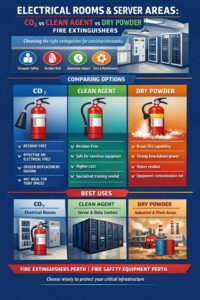
CO₂
Pros: residue-free, suitable for electrical fires, widely recognised, effective for fast response
Cons: oxygen displacement risk, less suitable in confined occupied spaces, forceful discharge, limited cooling effect
Clean agent
Pros: residue-free, better for sensitive electronics, controlled discharge, supports continuity planning
Cons: higher cost, may require more targeted training, not always necessary for every plant area
Dry powder
Pros: broad fire-class capability, strong fire knock-down, useful in mixed hazard environments
Cons: heavy residue, high contamination risk, difficult clean-up, poor fit for server and electronics rooms
Which option is usually best?
There is no universal answer for every site, but in many server and communications environments, clean agent extinguishers are often the most suitable portable option because they balance suppression performance with equipment protection. CO₂ can still be appropriate, especially in certain electrical plant rooms, but it must be assessed carefully against occupancy and ventilation conditions. Dry powder is generally the least suitable choice for enclosed server areas because of residue damage and recovery implications.
The right decision depends on factors such as:
- whether the room is normally occupied
- whether the area contains sensitive electronics or heavier electrical infrastructure
- room size and ventilation
- nearby fire classes and mixed hazards
- business continuity requirements
- maintenance, inspection, and training arrangements
Final point
Electrical rooms and server areas should never be treated as standard extinguisher locations. The correct extinguisher type should reflect the real operational risk of the space, the people who may need to use it, and the value of the equipment being protected. When businesses review Fire safety Equipment Perth needs for these environments, they should look beyond minimum compliance and assess how extinguisher choice affects safety, asset protection, and downtime. A well-matched extinguisher supports not only emergency response, but also faster recovery and more reliable protection of critical infrastructure.



Leave A Comment