


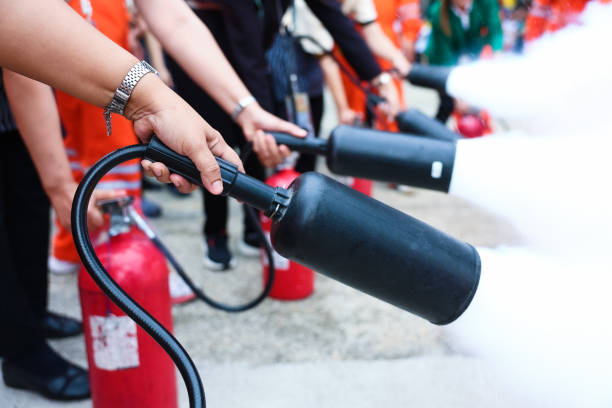
For businesses managing Fire extinguishers Perth requirements, maintenance is not a single task completed once a year. It is a layered compliance responsibility that combines regular visual checking, scheduled professional servicing, record keeping, and longer-term integrity testing. The same applies across wider Fire safety Perth obligations, where equipment must not only be present, but also accessible, correctly identified, and capable of operating when needed. Australian guidance and related standards require routine extinguisher inspections at defined intervals, with some servicing work reserved for competent, accredited, or licensed providers.
Why these three maintenance levels are different
Monthly checks, annual servicing, and hydrostatic testing serve different purposes. A monthly check is a simple readiness review. It is designed to confirm that the extinguisher is still where it should be, has not been obstructed, damaged, discharged, or tampered with, and appears ready for use. By contrast, scheduled servicing is a formal maintenance activity carried out against technical standards and service schedules. Hydrostatic testing goes further again. It is not a routine visual inspection at all, but a pressure-integrity test used to confirm that the cylinder itself remains safe for continued service.
Monthly checks: the first line of maintenance
A monthly check is best understood as an in-house operational control. Manufacturer guidance describes this as a regular quick check to confirm the extinguisher is available and in operating condition, and to verify that it has not been actuated or tampered with. In practice, that means checking that the unit is in its designated place, easy to access, physically undamaged, and showing normal pressure where a gauge is fitted.
This stage matters because many extinguisher failures are not technical failures in the cylinder or agent. They are basic readiness failures. A unit may be blocked by stock, missing from its bracket, corroded externally, missing its pin, or carrying illegible instructions. AMSA’s guidance on portable extinguishers reflects this operational focus by listing checks around accessibility, anti-tamper devices, legible instructions, maintenance tags, external damage, corrosion, and hose condition. Even where a business relies on external contractors for formal servicing, these practical checks still need to be part of site management.
Annual servicing: more than a once-a-year glance
Many businesses refer to “annual servicing” as if it covers the whole maintenance requirement. That shorthand can be misleading. Australian guidance tied to AS 1851 identifies regular inspection intervals at six-monthly, yearly, and five-yearly points, rather than treating extinguisher maintenance as a single annual event. In other words, yearly servicing is important, but it sits within a broader maintenance framework.
The annual service is the point at which the extinguisher receives a more structured technical review by a competent provider. AMSA states that the 12-monthly and five-yearly service and inspection must be completed by an accredited or licensed service provider, with service certification retained as evidence of compliance. That distinction is important because annual servicing is not just about looking at the outside of the unit. It is about confirming continued compliance with the applicable service standard, validating records, and identifying whether deeper maintenance or replacement is required.
For businesses, this is where record keeping becomes as important as the physical inspection itself. Comcare notes that inspection and testing intervals for emergency and fire protection items are specified in applicable standards, and organisations should maintain contracts, logs, and inspection records showing that maintenance has actually been performed. A compliant extinguisher program therefore includes both the service event and the documentary evidence behind it.
Hydrostatic testing: checking cylinder integrity, not just appearance
Hydrostatic testing is different from both the monthly check and the annual service because it is aimed at the structural integrity of the pressure vessel. External appearance alone does not prove that an extinguisher cylinder can safely hold pressure over time. Pressure testing is used where the applicable standard, cylinder rule, or manufacturer schedule requires it. In Australia, related fire equipment and cylinder guidance references hydrostatic testing in accordance with pressure vessel standards such as AS 2030.5 and AS 2337.1, and some hydrostatic test work is restricted to licensed testing stations.
This is why hydrostatic testing should never be treated as a casual extension of a visual service visit. It is specialist work. Training.gov.au describes hydrostatic testing of portable and wheeled CO2 fire extinguishers as restricted procedures carried out at a licensed testing station. That tells businesses two things. First, not every provider or on-site staff member can perform this work. Second, hydrostatic testing belongs to a different risk category because it directly concerns the safety and suitability of the cylinder for continued use.
It is also important to understand that not all extinguishers follow one identical long-term testing cycle. Worksafe WA guidance points to AS 1851 as the maintenance framework and notes regular inspection intervals at six-monthly, yearly, and five-yearly stages. Manufacturer instructions and specific extinguisher type also matter. That is why businesses should avoid assuming that every extinguisher on site reaches hydrostatic testing on the same timeline. The correct interval depends on the extinguisher type, the cylinder standard, and the relevant service instructions.
What businesses should take from this
The practical lesson is straightforward. Monthly checks help catch obvious readiness issues early. Annual servicing confirms formal compliance and technical condition through a competent provider. Hydrostatic testing addresses the deeper question of whether the cylinder itself remains safe and serviceable under pressure. Each layer addresses a different risk, and none of them fully replaces the others.
For businesses reviewing Fire extinguishers Perth responsibilities, the strongest approach is to build a maintenance program that separates daily ownership from scheduled technical servicing. Staff can monitor access, condition, and tagging, while accredited service providers manage formal inspections, certifications, and pressure testing obligations. That same structured approach supports broader Fire safety Perth compliance by reducing the risk of overlooked equipment, incomplete records, and unserviceable extinguishers remaining in place when they may be needed most.



Leave A Comment