



Fire extinguishers need to be readily accessible, clearly identifiable & protected from conditions that could affect their serviceability. While the extinguisher itself is the main fire protection device, the cabinet, stand or bracket used to store and position it also plays an important role.
For commercial properties, warehouses, workshops, retail premises, offices, industrial facilities & outdoor work areas, selecting the correct mounting or storage option depends on the location, environmental exposure, traffic levels & accessibility requirements. Businesses assessing Fire Extinguisher Perth requirements should therefore consider not only the extinguisher type, but also how each unit will be protected and positioned.
Why Extinguisher Storage & Mounting Matters
An extinguisher needs to remain accessible when required. Poor positioning can make equipment difficult to locate, expose it to accidental damage or allow environmental conditions to affect its condition.
Suitable cabinets, stands & brackets can help:
- Keep extinguishers in designated locations
- Reduce accidental movement or damage
- Protect equipment from dust, moisture & weather exposure
- Make extinguisher locations easier to identify
- Support organised fire protection throughout a property
- Prevent extinguishers from being placed directly on floors
- Maintain accessibility within workplaces & public areas
The most appropriate solution varies considerably between an indoor office corridor and an exposed loading yard, for example.
Fire Extinguisher Cabinets
Fire extinguisher cabinets provide an enclosed location for storing extinguishers while keeping them visible and accessible.
Cabinets can be particularly useful where equipment may otherwise be exposed to contamination, impact or environmental conditions.
Indoor Extinguisher Cabinets
Indoor cabinets are commonly used in commercial buildings, apartment common areas, schools, healthcare facilities, retail premises & industrial buildings.
They can help protect extinguishers from:
- Dust
- Accidental knocks
- General workplace traffic
- Tampering
- Dirt & debris
- Minor environmental contamination
A cabinet can also create a consistent visual location for fire equipment throughout a larger property.
Depending on the building environment, cabinets may be recessed into walls, surface mounted or installed in locations where extinguisher protection needs to be combined with clear visibility.
Outdoor Extinguisher Cabinets
Outdoor conditions create additional challenges. Extinguishers positioned outside may be exposed to rain, moisture, direct sunlight, dust, wind, salt air or industrial contaminants.
Outdoor cabinets are therefore typically designed to provide greater environmental protection.
They can be appropriate around:
- Loading docks
- Fuel storage areas
- Workshops
- Construction sites
- Outdoor plant areas
- Warehouses
- Industrial yards
- Car parks
- Agricultural facilities
- Marine environments
Where equipment is exposed to the elements, the enclosure itself should also be inspected regularly for deterioration, damaged seals, corrosion or other issues that could reduce its protective function.
Fire Extinguisher Stands
Not every extinguisher can or should be mounted directly to a wall. In these situations, a freestanding extinguisher stand may provide a practical alternative.
Stands are commonly used where wall mounting is unsuitable or where the building layout needs flexibility.
Examples include:
- Retail environments
- Exhibition areas
- Temporary workplaces
- Warehouses
- Open-plan commercial areas
- Events
- Construction sites
- Areas with glass partitions
- Locations where wall penetration is undesirable
A stand creates a dedicated extinguisher position without relying on a permanent wall fixture.
For Fire safety Perth planning, stands can also help businesses establish clearly defined equipment points within open or changing workspaces.
Indoor Extinguisher Stands
Indoor stands are particularly useful where maintaining clear floor layouts and visible fire equipment locations is important.
A properly positioned stand should not obstruct normal pedestrian movement, emergency exits or access routes. It should also provide sufficient stability so the extinguisher cannot easily be knocked over.
Some stands incorporate identification signage or mounting points that make the extinguisher more noticeable from a distance.
This can be useful in larger spaces where wall-mounted equipment may otherwise be difficult to identify.
Outdoor Extinguisher Stands
Outdoor stands require additional consideration because they may be exposed to wind, rain, vehicle movement and changing site conditions.
In some situations, a stand may be combined with an extinguisher cabinet or protective cover. This allows the extinguisher to remain in a designated location while receiving additional environmental protection.
Outdoor installations should be sufficiently secure to prevent equipment from becoming unstable or being moved unintentionally.
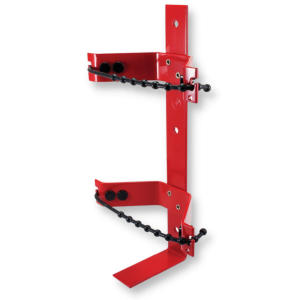
Fire Extinguisher Wall Brackets
Wall brackets are among the most common extinguisher mounting solutions.
A suitable bracket keeps the extinguisher off the floor & helps maintain a consistent position. It can also reduce the likelihood of an extinguisher being moved during cleaning, storage changes or general workplace activity.
Wall brackets may be appropriate for:
- Offices
- Commercial kitchens
- Workshops
- Warehouses
- Plant rooms
- Retail buildings
- Apartment common areas
- Educational premises
The bracket must be suitable for the extinguisher being installed. Different extinguisher sizes and cylinder designs may require different mounting arrangements.
Vehicle & Heavy-Duty Brackets
Standard wall brackets are not suitable for every environment.
Vehicles, machinery & mobile equipment can expose extinguishers to vibration, movement and impact. More secure mounting systems may therefore be needed.
Heavy-duty brackets are commonly considered for:
- Work vehicles
- Trucks
- Agricultural machinery
- Mining equipment
- Mobile plant
- Four-wheel-drive vehicles
- Commercial fleets
The extinguisher should remain securely restrained during normal vehicle operation while still being accessible when required.
Indoor vs Outdoor Protection
The primary difference between indoor and outdoor extinguisher protection is environmental exposure.
Indoor environments are generally more controlled. Outdoor environments can expose equipment to moisture, heat, sunlight, dirt and corrosive conditions.
Indoor considerations include:
Accessibility
Equipment should be positioned where it can be reached without unnecessary obstruction.
Visibility
Extinguisher locations should remain clearly identifiable.
Workplace traffic
Busy corridors, warehouses & operational areas may require additional protection against impact.
Building layout
Wall construction, floor plans & tenancy arrangements can influence whether brackets, stands or cabinets are most appropriate.
Outdoor considerations include:
Rain & moisture
Ongoing moisture exposure can contribute to deterioration of equipment and mounting components.
UV exposure
Direct sunlight and heat can affect outdoor equipment over time.
Dust & contamination
Industrial sites, construction areas and workshops can expose equipment to significant dust or debris.
Corrosive environments
Coastal, marine and industrial environments may require closer attention to corrosion.
Physical impact
Forklifts, vehicles, machinery & materials handling can create a greater risk of accidental damage.
Commercial Kitchens Require Additional Consideration
Commercial kitchens contain heat, cooking oils, grease, moisture & frequent staff movement.
Fire extinguishers need to remain protected without being located so close to cooking equipment that they become difficult or unsafe to access during an incident.
Cabinets and brackets may also accumulate grease or contamination over time, making routine inspection important.
Fire blankets and other relevant fire protection equipment should also have clearly designated locations appropriate to the kitchen layout and associated risks.
Warehouses & Industrial Facilities
Warehouses often combine open floor areas, shelving, vehicle movement, machinery & changing stock configurations.
This can make extinguisher positioning more complex.
Equipment should not become hidden behind stock, pallets or temporary storage. Where wall mounting is impractical, stands may provide identifiable equipment points within larger operational areas.
Areas exposed to forklifts or materials handling equipment may also require consideration of physical protection.
A comprehensive approach to Fire Extinguisher Perth placement should account for both the fire risks present and the practical conditions surrounding each extinguisher location.
Protecting Extinguishers Does Not Mean Hiding Them
One of the key considerations when using cabinets is ensuring that protection does not reduce accessibility.
An extinguisher should not become difficult to identify or retrieve simply because it has been placed inside an enclosure.
Cabinets should be recognisable as fire equipment locations, while doors or covers should remain functional.
Objects, furniture, stock or equipment should not be positioned in front of an extinguisher cabinet.
Inspection & Maintenance of Cabinets, Stands & Brackets
Fire extinguisher maintenance should include attention to the equipment used to support and protect the extinguisher.
Checks may identify:
- Loose brackets
- Damaged mounting points
- Corrosion
- Broken cabinet doors
- Damaged hinges
- Cracked covers
- Missing components
- Unstable stands
- Obstructed access
- Signs of moisture entry
- Equipment that has been moved
Outdoor installations generally require closer attention because weather exposure can accelerate deterioration.
An intact extinguisher does not necessarily mean the surrounding mounting system is suitable. Cabinets, brackets & stands need to remain functional as part of the overall fire equipment arrangement.
Matching Protection to the Environment
There is no single extinguisher mounting solution suitable for every property.
A standard wall bracket may work effectively in an office, while an industrial yard could require an enclosed cabinet. An open retail floor may benefit from a freestanding unit, while a commercial vehicle may require a heavy-duty retaining bracket.
The selection should consider:
- Extinguisher size
- Fire risk
- Indoor or outdoor location
- Weather exposure
- Building construction
- Traffic levels
- Potential for impact
- Visibility
- Accessibility
- Workplace layout
- Environmental contamination
These factors help determine whether a cabinet, stand, wall bracket or specialised mounting arrangement is appropriate.
Maintaining Reliable Fire Equipment Protection
Extinguisher cabinets, stands & brackets may appear to be secondary components, but they support the accessibility, protection & organisation of essential fire equipment.
Indoor locations generally require protection against workplace activity, obstruction and accidental damage, while outdoor installations need greater consideration of weather, corrosion, contamination & physical exposure.
Businesses reviewing Fire safety Perth requirements should include extinguisher mounting and storage arrangements as part of ongoing fire equipment inspections. Selecting equipment suited to the operating environment helps keep extinguishers identifiable, accessible & protected throughout their service life.




Leave A Comment